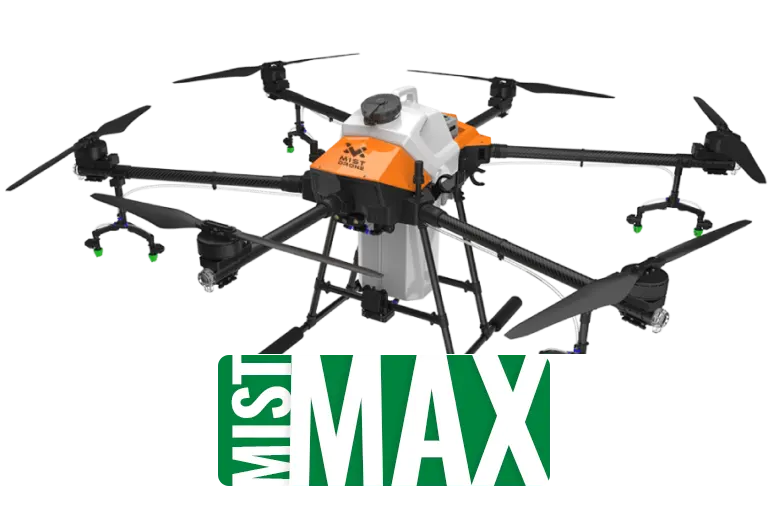
The Mist Max agricultural spraying drone, an eight-rotor airframe with a white and orange tank body, folding arms and spray booms mounted beneath.

Agriculture

Mist Max

A blanket and point-to-point spraying drone from the Mist Drone range, built in Malaysia for paddy, farmland and open-field crops.

Mist Max specifications

Spraying system

Tank capacity
20 litres
Pump type
Brushless
Max flowrate
4 litres per minute
Spraying configuration
Customisable nozzles, droplet size and volume

Power

Recommended battery
14S 22,000mAh

Flight features

Obstacle avoidance
Standard
Terrain following
Standard
Spreader system
Optional, swaps in place of the tank

Control

Remote controller
SkyDroid H12
Mission planning
Agri Assistant app, repeatable automated missions
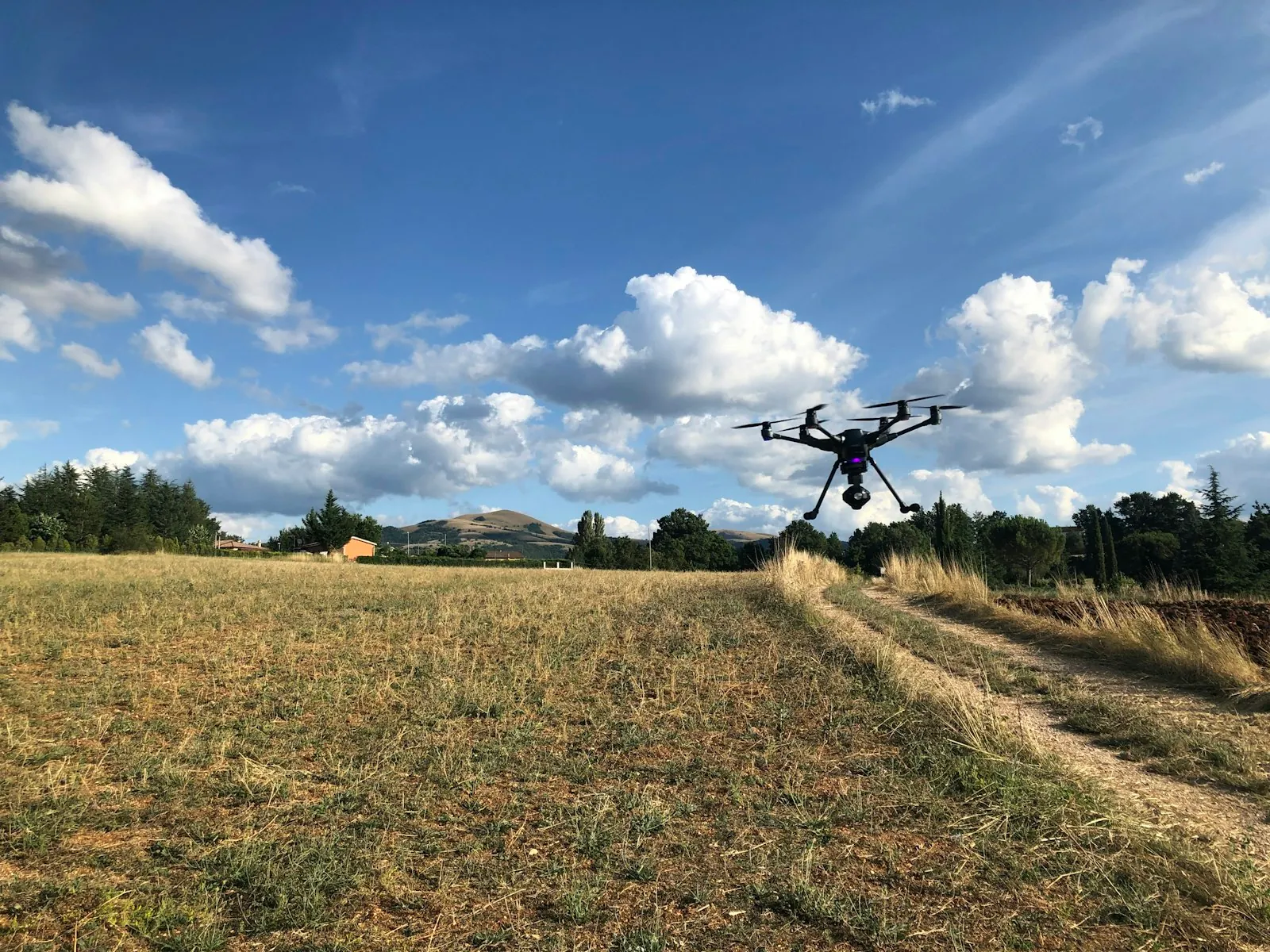
A dark multirotor drone hovering low over a mown field under a wide sky with scattered cloud, hills on the horizon.

Blanket and point-to-point, on one airframe

Mist is short for Mobile Intelligent Sustainable Tech. The range covers blanket spraying across open ground and point-to-point application where only part of a block needs treating, which is the difference between covering a paddy field and treating individual trees.

Spray pressure, droplet size and volume are all adjustable through interchangeable nozzles. That is the mechanism behind the usual claim about reducing chemical use: material goes where it is needed, at the rate it is needed, rather than uniformly across everything.

The second reason estates move to drone spraying is exposure. Nobody walks a treated block with a backpack sprayer.
What the aircraft actually does

Two spraying modes on one airframe

Blanket spraying covers open ground uniformly, which is what paddy and field crops need. Point-to-point treats individual targets, which is what a plantation needs when only part of a block is affected. One airframe does both, so an estate does not buy two aircraft to cover two jobs.

Nozzles you can actually change

Spray pressure, droplet size and volume are set through interchangeable nozzles rather than fixed in software. This is the mechanism behind reduced chemical use: material lands where it is needed at the rate it is needed, instead of uniformly across everything including the ground.

Swap the tank for a spreader

The tank lifts out and a spreader system takes its place, for granular products such as seed and fertiliser. It is an option rather than standard fit, so it is worth specifying at the point of order if spreading is part of the plan.

Plan once, fly it repeatedly

Missions are planned on the Agri Assistant app and flown from a SkyDroid H12 controller, and a planned mission can be repeated. Obstacle avoidance and terrain following are standard, which is what keeps altitude consistent over uneven ground instead of over-spraying the low parts.